
What is the best treatment for chronic pain after a car accident? It depends on how far the injury has progressed, what’s been tried already, and whether the underlying structural and neurological damage has been fully addressed. Most people assume a crash injury heals in a matter of weeks, rest, some ice, maybe a prescription, then life goes back to normal. But roughly 45% of crash victims still report pain two years after the collision, many of them reporting persistent pain despite following recommended care. That gap between expectation and reality is where chronic post-accident pain lives.
The research on why this happens has advanced considerably. The problem is that some care plans lag behind recent research. Providers may treat the visible injury and move on, leaving the structural and neurological aftermath unaddressed. This article walks through the full treatment picture for chronic pain after a car accident: from first-line rehab to interventional procedures, to the deeper work that most conventional plans never reach. That last category is where practices like Complete Bodywork in Orem, Utah operate, treating collision injuries as a whole-body structural and neurological problem rather than a list of symptoms to manage.
Why Crash Injuries Become Chronic
During a collision, your body absorbs rapid deceleration forces that tear soft tissue, compress spinal structures, and trigger immediate nerve sensitization. The nervous system registers this as a serious threat and responds accordingly, tightening muscles around the injury site to protect it. That protective response is useful in the short term. Over months and years, it creates the problem.
Clinically, pain becomes chronic when it persists beyond three months. That threshold matters because it shifts the treatment framework entirely: you’re no longer managing an acute injury, you’re working with a sensitized nervous system that has reorganized itself around protecting a threat that may no longer exist structurally. Research on MVC injuries shows that chronic widespread pain often begins in the immediate aftermath of the collision rather than developing gradually. That means early recovery doesn’t guarantee you’re out of the woods, and it means the window for effective intervention matters more than most people realize.
The clearest predictors of long-term post-traumatic chronic pain are injury type (whiplash, herniated discs, nerve damage), psychological factors like peritraumatic distress and PTSD symptoms, delayed treatment, and pre-existing conditions. Of those, early and consistent care is the most modifiable factor. That context matters for what an effective care plan should actually include.
What Is the Best Treatment for Chronic Pain After a Car Accident? Start Here.
Physical therapy is the cornerstone of recovery after a motor vehicle collision. It restores range of motion, corrects movement compensations, and rebuilds muscle support around injured structures. PT produces more durable outcomes than medication alone because it addresses functional restoration, not just pain levels. That distinction matters when the goal is getting your life back, not just bringing your comfort score down. Learn more about our Athletic Injury & Sport Performance approach for collision and sport-related recovery.
On the medication side, NSAIDs are the preferred pharmacological option for acute post-accident pain. High-quality research shows they produce equivalent outcomes to opioids at six weeks with a significantly safer risk profile. The 2022 CDC guidelines are clear: opioids are not first-line for musculoskeletal injuries and should be prescribed at the lowest effective dose if used at all. Short courses are typically sufficient, three days or fewer is often adequate, and more than seven days is rarely needed. For most crash injuries, opioids are a bridge, not a solution.
Chiropractic care, massage therapy, and electrical stimulation round out the first-line toolkit as adjuncts to PT. Used in sequence with a structured physical therapy program, they reduce muscle tension, relieve joint pressure, and address localized nerve discomfort. They work best alongside PT, not instead of it.
Interventional Procedures for Pain That Doesn’t Resolve
When first-line rehab doesn’t produce sufficient relief, interventional procedures become the next logical step. Medial branch blocks serve a dual purpose: they confirm whether facet joint pain is the primary driver, and they provide short-term therapeutic relief in 60 to 80% of patients. For many, that relief extends beyond the anesthetic window, averaging around three months.
If a medial branch block confirms facet involvement, radiofrequency ablation is the stronger long-term option. Approximately 70% of confirmed responders achieve meaningful relief lasting six to twelve months, with higher patient satisfaction than injections alone. For radicular pain rooted in disc herniation, epidural steroid injections are the standard approach, providing relief for one to three months in a substantial portion of patients; research suggests roughly 50 to 70% experience meaningful improvement.
These procedures are effective at what they do. The honest caveat is that they manage pain generators without correcting the structural conditions that keep those generators active. That matters for anyone focused on long-term recovery rather than cyclical symptom control.
The Structural and Neurological Piece Most Care Plans Miss
After a collision, the body adopts compensatory postures to protect injured tissue. Those postures alter muscle length-tension relationships throughout the entire kinetic chain. This is why someone who received appropriate whiplash treatment may later develop shoulder pain, hip pain, or migraines. The original injury site improved; the structural compensation it created did not.
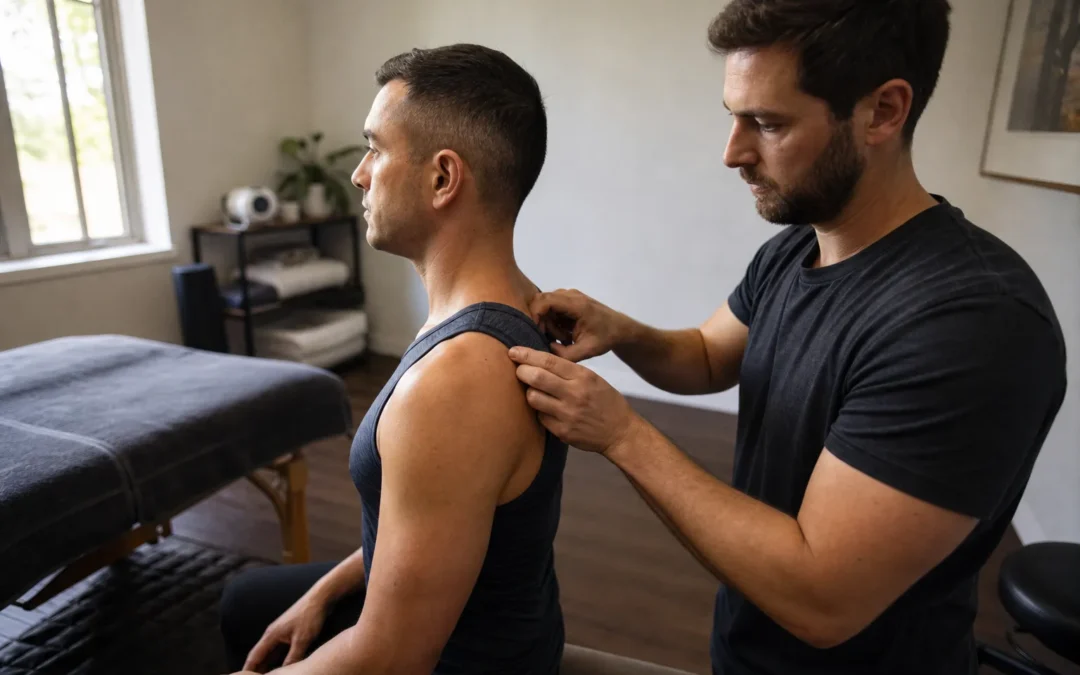
Neurosomatic therapy addresses this layer directly. Where physical therapy focuses on strengthening and retraining movement, neurosomatic therapy identifies and corrects the altered structural and neurological patterns driving secondary pain. At Complete Bodywork, Benjamin begins each case with a precise postural measurement and a full patient history before any treatment starts. That assessment maps the actual structural picture, the asymmetries, the compensatory loading, the nerve tension patterns that standard imaging typically does not capture. Trigger Point Therapy: What It Is and How It Works and targeted correction of altered length-tension relationships then target the root drivers rather than the downstream symptoms.
This intake process is specifically designed for people who have already moved through the conventional system without lasting resolution. A thorough structural evaluation at the outset changes the entire direction of care, it identifies what hasn’t been assessed yet rather than repeating what hasn’t worked.
Building a Care Plan That Actually Holds
The outcome data for integrated, multidisciplinary care is hard to ignore. Programs combining physical, neurological, and psychological support achieve a 67% return-to-work rate compared to 24% with conventional care alone, with 95% patient satisfaction in coordinated programs. No single modality produces those numbers. The combination does.
There are also situations that require urgent evaluation rather than a gradual escalation of conservative care. The following warning signs warrant prompt specialist attention:
- Radiating pain into an arm or leg
- Progressive neurological symptoms
- Loss of bladder or bowel function
- New or worsening pain patterns, particularly those accompanied by neurological findings
Persistent symptoms are data, not noise.
Frequently Asked Questions: Best Treatment for Chronic Pain After a Car Accident
How long does chronic pain last after a car accident?
Pain is classified as chronic once it persists beyond three months. Research shows that roughly 45% of crash victims still report pain two years after the collision. How long it lasts depends on injury type, how quickly treatment began, and whether the full structural and neurological picture has been addressed, not just the original injury site.
Is physical therapy enough for post-accident chronic pain?
PT is the most evidence-supported first-line treatment for pain management after a car crash, but it isn’t always sufficient on its own. For patients whose pain has become chronic, especially when secondary symptoms have appeared, shoulder pain, headaches, hip issues that weren’t part of the original injury, a structural and neurological evaluation often reveals compensation patterns that standard PT protocols don’t address.
When should you consider interventional procedures?
Interventional procedures like medial branch blocks, radiofrequency ablation, and epidural steroid injections are appropriate when first-line conservative care hasn’t produced adequate relief. They’re most effective when used as part of a broader care plan rather than as a standalone solution.
What does neurosomatic therapy offer that standard care doesn’t?
Standard care tends to focus on the diagnosed injury site. Neurosomatic therapy maps the full structural and neurological aftermath of a collision, the compensatory postures, altered muscle patterns, and nerve tension that develop in response to the original trauma. For people with treatment-resistant chronic post-accident pain, that broader assessment often identifies what earlier care missed.
If chronic pain after a car accident has outlasted conventional treatment, the next step isn’t a longer wait or another prescription. It’s identifying what hasn’t been assessed yet. That usually means a full structural evaluation from a provider who examines the whole body, not just the original injury site. If you’re in Utah County and that’s where you are right now, Complete Bodywork offers exactly that starting point, a root-cause approach that looks at the structural and neurological picture standard care often leaves unexamined. For many people dealing with treatment-resistant post-MVC chronic pain, that difference is what produces lasting relief instead of another plateau. To take the next step, please Contact | Complete Bodywork.